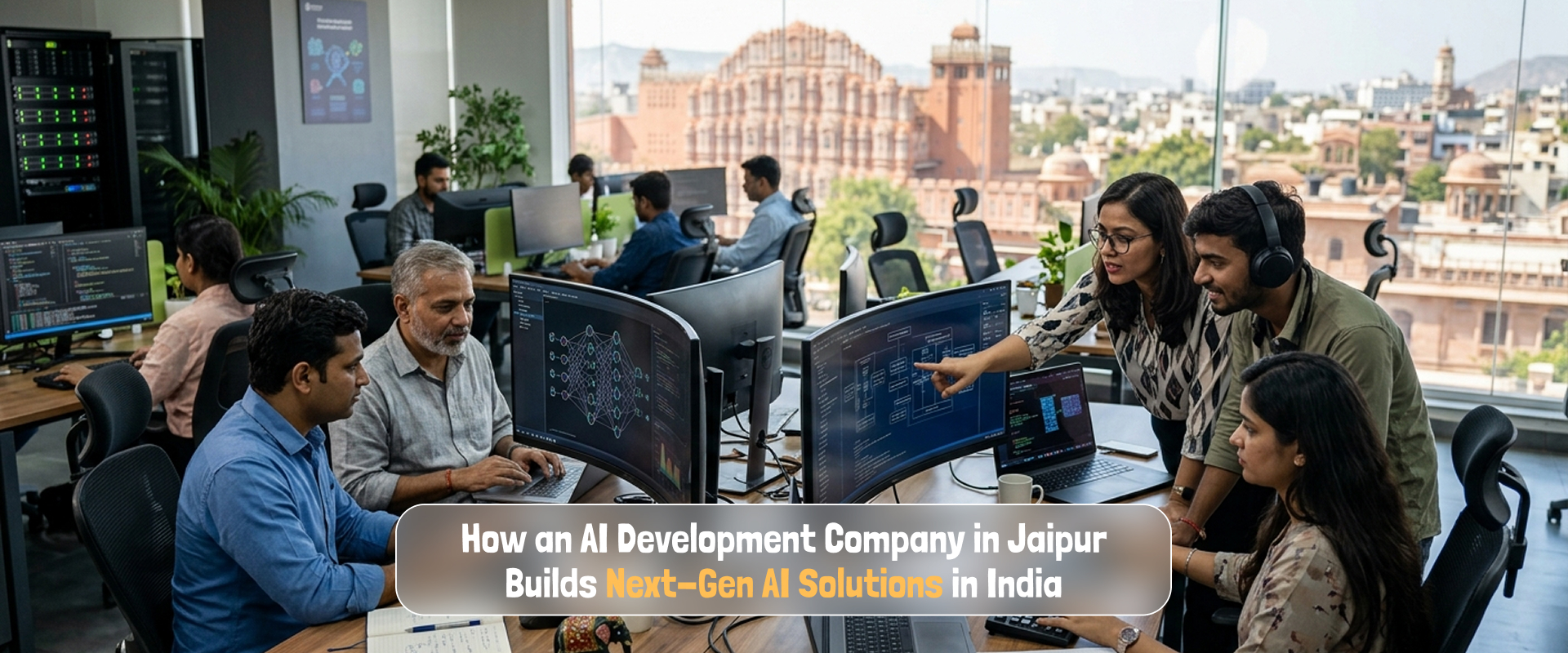
The landscape of technology across India is changing at an incredible pace. Businesses no longer look at artificial intelligence as a distant luxury. Instead, they see it as a core necessity to stay competitive, streamline chaotic workflows, and understand customer behavior. While metropolitan areas like Bengaluru and Mumbai have traditionally grabbed the spotlight for tech innovation, a significant shift is occurring. Jaipur has quietly and steadily emerged as a powerful hub for engineering and software creation. Local firms are proving that world-class software infrastructure does not require a tier-one city address. When looking at how modern businesses implement these technologies, studying the exact methodology of an AI Development Company Jaipur offers a clear blueprint of real-world application.
Building modern enterprise applications requires moving past basic automation. It demands systems that can think, adapt, and reason through complex scenarios. Engineering teams in Rajasthan are now combining deep regional talent with global development standards to change how industries operate. By looking closely at the internal processes, architecture choices, and real-world execution strategies, we can understand exactly how a premier AI Development Company Jaipur constructs Next-Gen AI Solutions India for a global market.
The Shift From Simple Automation to Agentic Systems
For years, corporate automation relied heavily on rigid, rules-based logic. If a customer clicked button A, the system triggered response B. While this approach worked for basic database updates or standard email workflows, it completely failed when faced with unstructured data, unexpected human inputs, or shifting market conditions.
Today, engineers at Sumedha Softech focus heavily on agentic workflows. Agentic systems do not just follow a static list of commands. They are given a high-level goal, analyze the environment, break the objective down into smaller tasks, and execute those tasks independently.
For example, in supply chain management, an older system might simply alert a manager when inventory levels fall below a specific number. A modern system handles the entire problem. It looks at historical sales patterns, checks current market shipping delays, contacts vendor software systems to check pricing, and drafts an optimal purchase order for review. The focus changes from basic data processing to actual decision intelligence. This practical engineering approach allows businesses to eliminate systemic bottlenecks and repurpose human teams for high-level strategy rather than repetitive data entry.
Architectural Blueprints of Modern Intelligent Software
Creating robust applications that do not break under heavy data loads requires a carefully planned tech stack. The development process typically begins with data ingestion and engineering, moving smoothly into model selection, training, and secure deployment.
1. Data Engineering and Clean Ingestion
An intelligent model is only as good as the information it processes. Raw enterprise data is almost always messy, fragmented, and spread across various legacy databases, old spreadsheets, and isolated text files. The initial phase focuses heavily on building secure data pipelines that clean, normalize, and mask sensitive corporate details. This ensures absolute compliance with data privacy regulations before any training or processing begins.
2. Hybrid Model Frameworks
Relying on a single massive model for every single business task is highly inefficient and creates massive operational costs. Instead, development teams design hybrid systems. Large Language Models (LLMs) handle conversational tasks, sentiment analysis, and natural language understanding. At the same time, smaller, highly specialized machine learning algorithms run in parallel to process numerical forecasting, predictive maintenance schedules, and pattern recognition.
3. Retrieval-Augmented Generation (RAG)
To make large language frameworks useful for actual corporate operations, they must have access to real-time, accurate business records without suffering from data hallucinations. By implementing RAG frameworks, engineers connect the central processing models to secure vector databases containing internal company documentation, past invoices, and product guides. The system retrieves precise facts first, then uses the language model to write a highly contextual response.
Key Technological Pillars Driving Enterprise Growth
When an AI Development Company Jaipur partners with a growing enterprise, the goal is always to deliver measurable business utility. This utility is generally achieved through four primary technical avenues:
Document Intelligence and NLP
Unstructured paperwork like legal agreements, vendor invoices, and medical charts costs companies thousands of hours in manual review. Using advanced Natural Language Processing (NLP), systems can scan massive, multi-page PDFs, identify key clauses, extract financial values, and automatically populate the data directly into internal ERP software. This turns static paper documents into highly organized, fully searchable digital assets instantly.
Vision Systems for Industry
Computer vision has moved far beyond simple facial recognition software. In manufacturing and retail landscapes, real-time video analytics systems monitor production lines to catch tiny structural defects that human eyes might completely miss. In logistics centers, vision software tracks inventory movement, scans barcodes automatically, and flags safety hazards on the warehouse floor to prevent workplace accidents.
Predictive Intelligence
By analyzing historical sales numbers, weather patterns, economic indicators, and seasonal trends, predictive engines give leadership teams deep, data-backed foresight. Whether a business needs to forecast consumer demand for a specific retail item or predict exactly when a piece of heavy factory machinery will require maintenance, these models reduce operational risks and prevent costly, unplanned downtime.
Hyper-Personalization Tools
Modern consumers expect online platforms to understand their exact needs instantly. Personalization systems track subtle user interactions, past purchases, and contextual browsing behavior to display highly relevant product recommendations and customized content interfaces. This smooth user experience drastically improves conversion rates and fosters long-term customer retention.
Staying Ahead of Global Technology Trends
The technical landscape moves far too quickly for static software models. To build sustainable Next-Gen AI Solutions India, development teams must design applications with long-term flexibility in mind. This involves sticking closely to specific software engineering philosophies:
- Explainable Systems (XAI): Black-box applications that output answers without showing their underlying logic are dangerous for enterprise operations. Systems must be built to show their reasoning paths, allowing human operators to audit choices and verify accuracy easily.
- Privacy-First Design: Data breaches can ruin a brand overnight. Keeping enterprise data completely isolated through secure cloud environments, local data masking, and private server deployments ensures client records remain completely secure.
- Modular Codebases: By building applications using containerized microservices, separate components can be updated, tweaked, or replaced entirely without taking down the entire enterprise infrastructure.
By maintaining these rigorous development standards, Sumedha Softech ensures that local tech infrastructure seamlessly supports complex international business requirements.
Crucial Phases of the Development Journey
Building custom tools requires a structured, iterative framework to guarantee project success. The journey moves through deliberate technical stages:
- Discovery & Strategy: Deep analysis of the existing corporate software setup to find specific friction points where intelligent tools can provide the highest immediate return on investment.
- Prototyping & Feasibility: Developing a small, controlled proof-of-concept to test data compatibility and verify algorithm accuracy before scaling.
- Core Engineering: Training specific models, setting up secure API integrations, and building out intuitive, responsive user interfaces for the web and mobile devices.
- Rigorous Optimization: Subjecting the application to intense stress testing, bias checks, and latency adjustments to ensure rapid response times under heavy user loads.
- Deployment & Monitoring: Launching the system smoothly into production while maintaining continuous feedback loops to track model performance and prevent algorithmic drift over time.
Must Read: What Are AI Development Solutions for Business?
Frequently Asked Questions
Q1. How do you guarantee the security of sensitive corporate data when integrating intelligent tools?
Ans: Data privacy is handled at the foundational infrastructure level. All incoming information goes through rigorous scrubbing and data masking protocols to remove sensitive details before it interacts with any large language models. Furthermore, applications are deployed inside completely isolated, private cloud environments or secure on-premise servers, ensuring your proprietary operational data is never used for public model training.
Q2. What is the typical timeline required to build a custom enterprise application?
Ans: The engineering timeline depends heavily on project scope and data complexity. A focused proof-of-concept or a standard document processing tool can often be built and integrated within 8 to 12 weeks. Comprehensive, multi-tiered enterprise platforms that involve real-time predictive modeling, custom computer vision pipelines, and deep legacy software integration generally require 4 to 6 months of development.
Q3. Can these modern intelligent systems integrate with older, legacy ERP and CRM platforms?
Ans: Yes, modern platforms are built with a strong focus on compatibility. Engineers design custom API bridges and middleware layer infrastructure that allow new models to read from and write directly to your existing databases, legacy ERP frameworks, or traditional CRM platforms. This prevents the need for an expensive, disruptive overhaul of your current software setup.
Q4. How do agentic workflows differ from standard software automation routines?
Ans: Standard software automation relies entirely on pre-defined, rigid instructions; if a scenario deviates slightly from the script, the automation fails. Agentic workflows use reasoning models to evaluate a high-level goal. The system can independently choose which tools to use, handle unexpected variations in data, correct its own errors, and determine the best path forward to complete the assignment without constant human intervention.
Q5. What steps are taken to prevent models from generating inaccurate information or hallucinations?
Ans: To keep systems completely accurate, development teams rely heavily on Retrieval-Augmented Generation (RAG) frameworks. This approach grounds the model by forcing it to look up verified facts within a secure, internal company database before answering. By limiting the model’s response parameter specifically to the retrieved documents, the risk of incorrect data or hallucination is practically eliminated.