Artificial intelligence has moved well past the experimentation phase. For B2B businesses operating across global markets, AI solutions development is now a core part of how companies compete on efficiency, customer experience, and decision-making speed. According to Grand View Research, the global AI market was valued at roughly USD 390.9 billion in 2025 and is projected to climb toward USD 539.5 billion in 2026, growing at a compound annual rate of over 30% through 2033.
If your organization is still treating AI as a future initiative rather than a present-day priority, you risk falling behind competitors who have already started building AI into their products, workflows, and customer-facing systems. This guide breaks down what AI solutions development actually involves, why it matters for B2B enterprises, how the development process works, and where it delivers the most business value.
Quick Answer: AI Solutions Development is the process of designing, building, and deploying AI-powered systems — such as chatbots, predictive models, or automation tools — that solve specific business problems. For B2B companies, it typically involves a structured process (goal identification, data assessment, model development, integration, and monitoring) and delivers benefits like lower operational costs, faster decision-making, and improved customer experience.
What Is AI Solutions Development?
AI Solutions Development is the process of designing, building, and deploying intelligent systems that use machine learning, natural language processing, computer vision, or automation to solve specific business problems. Unlike generic software, AI-powered systems are built to learn from data, adapt over time, and make predictions or recommendations with minimal human intervention.
For B2B organizations, this typically means working with an AI development company to translate business goals, such as reducing operational costs, improving forecasting accuracy, or automating customer support, into a working AI system tailored to existing infrastructure and workflows.
Key Technologies Behind Modern AI Solutions
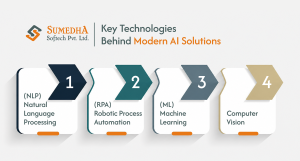
Before diving into benefits and use cases, it helps to understand the building blocks that most AI development services rely on.
Machine Learning (ML)
Machine learning enables systems to identify patterns in data and improve performance over time without being explicitly reprogrammed for every new scenario.
Natural Language Processing (NLP)
NLP allows software to understand, interpret, and generate human language, powering applications like chatbots, document analysis, and sentiment monitoring.
Computer Vision
Computer vision lets machines interpret images and video, which is widely used in quality inspection, inventory tracking, and security applications.
Robotic Process Automation (RPA)
RPA automates repetitive, rule-based tasks such as data entry, invoice processing, and report generation, freeing up teams for higher-value work.
Why B2B Businesses Need AI Solutions Development
Enterprise buyers are no longer asking whether to adopt AI, but how quickly they can do it well. Research from McKinsey’s 2025 Global AI Survey found that organizational AI usage has climbed sharply over recent years, with most companies now using AI in at least one business function. This shift is reshaping expectations across procurement, operations, and customer service teams worldwide.
For B2B companies specifically, AI integration addresses problems that are difficult to solve through traditional software alone: forecasting demand across unpredictable markets, personalizing outreach at scale, detecting fraud in real time, and managing complex supply chains across geographies.
Benefits of AI Solutions Development for Businesses
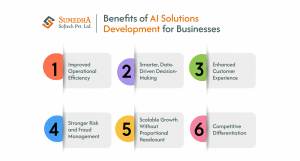
1. Improved Operational Efficiency
AI-powered automation reduces the time spent on manual, repetitive tasks across departments such as finance, HR, and customer support, allowing teams to focus on strategic work instead.
2. Smarter, Data-Driven Decision-Making
AI systems can process large volumes of structured and unstructured data far faster than human teams, surfacing insights that inform pricing, inventory, and go-to-market decisions.
3. Enhanced Customer Experience
From intelligent chatbots to personalized product recommendations, AI helps B2B companies deliver faster, more relevant interactions across the buyer journey.
4. Stronger Risk and Fraud Management
Machine learning models can flag anomalies in transactions, network activity, or compliance data in real time, reducing exposure to fraud and regulatory risk.
5. Scalable Growth Without Proportional Headcount
A well-built custom AI software development solution allows businesses to scale operations, support, and analysis without scaling staff at the same rate, improving margins as the company grows.
6. Competitive Differentiation
Companies that integrate AI early into their products and operations are better positioned to respond to market shifts faster than competitors relying on manual processes.
The AI Solutions Development Process
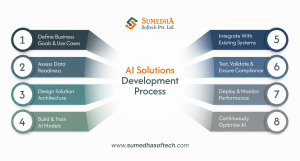
Building a successful AI system requires more than picking a tool off the shelf. Partnering with an experienced AI development company typically follows a structured process designed to reduce risk and ensure measurable ROI.
Step 1: Business Goal and Use Case Identification
The process starts by identifying the specific business problem AI should solve, whether that’s reducing support ticket resolution time, improving sales forecasting, or automating document processing.
Step 2: Data Assessment and Readiness Check
AI systems are only as good as the data behind them. This stage involves auditing existing data sources for quality, volume, and accessibility before development begins.
Step 3: Solution Architecture and Technology Selection
Teams decide whether to build a custom model from scratch, fine-tune an existing model, or integrate a third-party AI platform, based on budget, timeline, and long-term scalability needs.
Step 4: Model Development and Training
This is where the core AI development services come into play, building, training, and refining models using relevant business data so outputs are accurate and reliable.
Step 5: AI Integration With Existing Systems
The AI solution is connected to CRMs, ERPs, websites, or internal tools through APIs, ensuring it works seamlessly within existing business workflows rather than as a standalone system.
Step 6: Testing, Validation, and Compliance Review
Before launch, the system is tested for accuracy, bias, security vulnerabilities, and regulatory compliance, particularly important for businesses operating across multiple countries with differing data laws.
Step 7: Deployment and Performance Monitoring
After go-live, performance is tracked against defined KPIs, with ongoing fine-tuning to maintain accuracy as new data and business conditions evolve.
Step 8: Continuous Optimization
AI is not a one-time deployment. Markets, customer behavior, and data patterns evolve, so the system requires periodic retraining and updates to remain effective.
Want to Fast-Track Your Business with AI?
We deploy custom AI solutions in 6-8 weeks — from automation to predictive analytics — that deliver measurable business ROI.
Business Use Cases of AI Solutions Development
Customer Support Automation
AI-powered chatbots and virtual assistants resolve routine queries instantly, escalating complex issues to human agents only when necessary, reducing response times across global customer bases.
Sales Forecasting and Demand Planning
AI models analyze historical sales data, market trends, and external factors to generate more accurate forecasts, helping B2B businesses plan inventory and resources with greater confidence.
Fraud Detection and Risk Scoring
Financial institutions and B2B platforms use AI to monitor transactions in real time, flagging suspicious activity faster than manual review processes ever could.
Supply Chain and Logistics Optimization
AI helps predict delays, optimize routing, and manage supplier risk, which is especially valuable for businesses managing operations across multiple regions.
Personalized Marketing and Lead Scoring
By analyzing buyer behavior and engagement data, AI systems help sales and marketing teams prioritize high-intent leads and personalize outreach at scale.
Document Processing and Compliance Automation
NLP-powered systems extract and classify information from contracts, invoices, and compliance documents, cutting down manual review time significantly.
Predictive Maintenance
In manufacturing and asset-heavy industries, AI analyzes sensor data to predict equipment failures before they happen, reducing downtime and maintenance costs.
Choosing the Right AI Development Partner
Not every AI development company offers the same depth of expertise. When evaluating partners for AI solutions development, B2B businesses should look for:
- Proven experience delivering Custom AI Software Development projects in your industry
- Transparent processes for data security and regulatory compliance
- Strong post-deployment support for monitoring and optimization
- The ability to integrate AI into existing enterprise systems without major disruption
- Case studies or references demonstrating measurable business outcomes
At Sumedha Softech, our team works with global B2B businesses to design and deploy AI systems that are built around real operational goals rather than generic, one-size-fits-all models. From initial strategy through deployment and ongoing optimization, we help businesses turn AI integration into measurable returns.
Conclusion
AI solutions development is no longer a differentiator reserved for large enterprises with deep technical teams—it’s becoming a baseline requirement for B2B businesses that want to stay competitive in global markets. From automating routine operations to enabling smarter forecasting, fraud detection, and personalized customer engagement, the benefits compound quickly once the right system is in place.
The businesses that gain the most aren’t necessarily the ones that move fastest but the ones that approach AI integration with a clear use case, clean data, and a development partner who understands how to connect AI into existing workflows rather than bolting it on as an afterthought. Whether you’re exploring your first AI-powered chatbot or planning a full-scale custom AI software development initiative, this software development guide gives you a practical starting point for getting there.
If you’re ready to move from exploring AI to actually building it, Sumedha Softech can help you identify the right use case and turn it into a working solution.
Frequently Asked Questions
Q1. What are AI solutions developments?
AI Solutions Development is the process of designing, building, and deploying AI-powered systems, such as machine learning models, chatbots, or automation tools, to solve specific business problems and improve operational performance.
Q2. How long does it take to build a custom AI solution?
Timelines vary based on complexity, but most custom AI projects take anywhere from a few weeks for a focused proof of concept to several months for a fully integrated enterprise solution.
Q3. Is AI integration expensive for small and mid-sized B2B businesses?
Costs vary widely depending on scope. Many businesses start with a smaller, targeted use case, such as a chatbot or automation tool, before scaling to more complex AI development services as ROI is proved.
Q4. What industries benefit most from AI development services?
Finance, manufacturing, logistics, healthcare, retail, and professional services are among the industries seeing the strongest returns from AI adoption, though virtually every B2B sector can benefit from targeted use cases.
Q5. Do we need an in-house data science team to adopt AI?
No. Most B2B businesses partner with an external AI development company to handle model development, integration, and ongoing optimization, avoiding the cost and time required to build an in-house team from scratch.
Q6. How do you measure ROI from AI solutions?
ROI is typically measured against the original business goal, such as reduced support costs, faster processing times, improved forecast accuracy, or increased conversion rates, tracked through clearly defined KPIs set before deployment.
Ready to explore what AI solutions development could look like for your business? Get in touch with Sumedha Softech to discuss your use case and build a roadmap tailored to your goals.